If you talk to veteran durian lovers in Penang, they will speak of a champion cultivar that took home the prestigious crown back in 1990 and made a massive, award-winning comeback in recent years. Officially registered as D165, this elite fruit goes by many names: Green Skin (Kulit Hijau), Cheh Puay in Hokkien, Green Thorn (Cheh Chee), or even Green Dragon (Qing Long). Legend has it that this variety sprouted from the seed of a Thai Chanee (D15) tree, which explains why old-timers often call it “Green Skin 15”.
Because D165 is highly sought after for its intense, complex bitterness and deep, wine-like alcoholic kick, it commands a premium price during its tight harvest window from June to July. Unfortunately, its popularity means that unprincipled sellers occasionally try to pass off cheaper, regular green-husked durians or lesser clones as the real deal. To make sure you don’t get tricked at the fruit stall, here is the ultimate guide on how to visually and sensory-identify an authentic, true-to-tree D165 Green Skin durian.
1. The Exterior Inspection: Look for the "Beer Bottle Lip"
Before the seller even picks up the knife, you can completely verify a D165 by examining three highly specific physical traits on its outer husk.
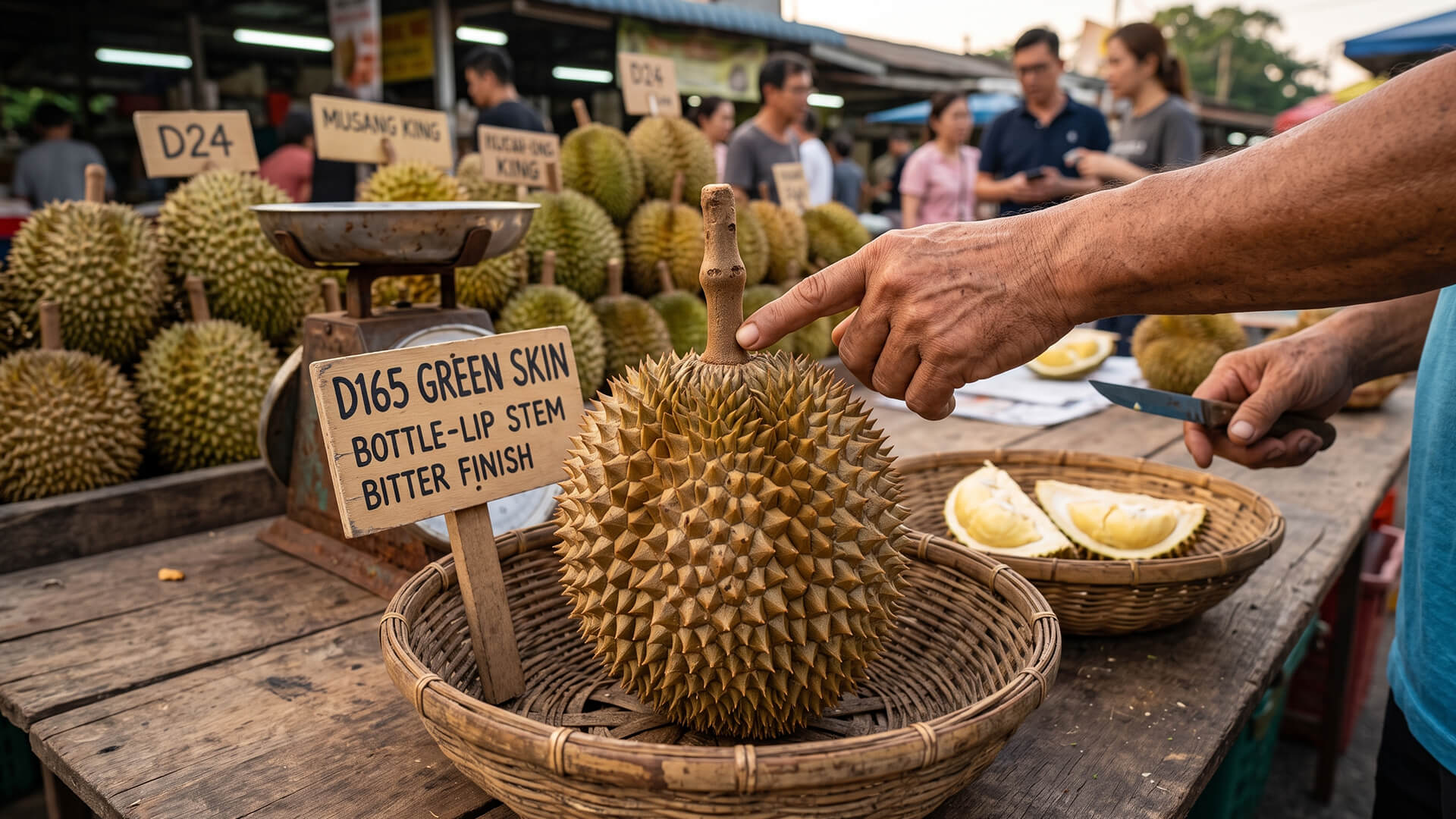
The Stem (The #1 Tell-Tale Sign)
The absolute best way to identify an authentic D165 is to look closely at the very top of its stem where it naturally separated from the tree branch. A genuine D165 Green Skin inherits a distinct trait from its Thai Chanee ancestry: a wide, prominent, flared “lip” at the tip. It looks exactly like the thick glass rim at the mouth of a beer bottle. If the stem is perfectly straight, thin, or lacks this smooth, thick “corona” rim, it is highly likely a lookalike or an entirely different clone.
The Husk Color and Shape
Do not just look for any random green durian. The D165 rind is an unapologetically deep, vibrant green. It is a large, heavy fruit, frequently weighing around 2kg or more. Shape-wise, it is rarely a perfect circle. Instead, it forms an elongated, oblong, or slightly crescent shape, often narrowing at one end to resemble a rustic pear or a rugby ball.
Warning for Buyers: If a seller offers you a perfectly round, small durian weighing around 1kg and calls it Green Skin, walk away. You are likely looking at a local miniature variant known as Green Skin Kia (Kacang Hijau) rather than the true premium D165 master clone
The Thorns
The spikes of a D165 are massive, broad, and widely spaced. They look like bold, armored spikes on a medieval warrior’s pauldrons. Despite this tough, aggressive exterior, the husk is surprisingly delicate and prone to splitting or cracking naturally at the seams upon hitting the ground.
2. The Interior Reveal: Glossy Butter and Wide Cores
Once the knife cracks open the crescent-shaped husk, pay close attention to the structural anatomy inside.
The Core Surface
When you peer into an opened D165, the white inner structural spine (where the fruitlets attach to the center core) takes up a noticeably larger surface area compared to regular durians.
Flesh Color
The arils boast a beautiful, uniform fresh-butter yellow color. On rare occasions, exceptional old-tree specimens can throw a darker, orange-tinted pastel hue, known by locals as Green Skin Ang Bak.
The Gloss
A true D165 has a highly reflective, glossy, and wet sheen over its skin. It looks luxuriously smooth, like it has just been glazed.
3. The Sensory Test: The Alcoholic Powerhouse
If the visual cues check out, the final, undeniable proof lies in the tasting.
The Texture
When you lift a pod, it should feel thick and substantial. The texture is incredibly creamy and wet, yet it possesses a signature property known in Hokkien as “liam chooi”, which is when it is beautifully sticky and clings intensely to the roof of your mouth. The seeds inside are regular, medium-sized, and wrapped neatly in slightly fibrous, heavy meat that fills your stomach quickly.
The Flavor and Aroma
The aroma is surprisingly light, clean, and carries a gentle, elegant floral note. But the flavor profile itself is a wolf in sheep’s clothing.
D165 is unashamedly a bitter-forward durian. While it carries a foundational sweetness, it is instantly overtaken by a massive, deep, tongue-numbing bitterness and a heavy gas profile that mimics taking a quick shot of premium whiskey. It packs such a significant sensory punch that seasoned tasters always recommend eating it at the absolute end of a feast. If you eat a D165 first, its lingering, alcoholic depth will make almost any other durian you taste afterward taste completely bland!
Conclusion: Taste True Authenticity at Dury Dury
Identifying a genuine D165 Green Skin requires an eye for detail, which requires remembering to check for that distinct beer-bottle stem lip, the hefty 2kg oblong build, and that unmistakable, deeply bitter, glossy butter flesh.
The easiest way to avoid lookalikes entirely is to source your fruit from a hub with an untarnished reputation. At Dury Dury in Kuala Lumpur, we cut out the guesswork. Our team directly sources authentic, old-tree D165 harvests straight from trusted multi-generational orchards in Penang during the peak mid-year season.
Ready to experience the legendary “Green Dragon” in its purest, most potent form? Drop by our air-conditioned lounge today, check our daily arrival boards, and let our experts crack open a certified, flawless D165 right at your table!